

New Public Standard Sets Ten Rights for People Affected by Automated Decisions, Free for Any Institution to Adopt
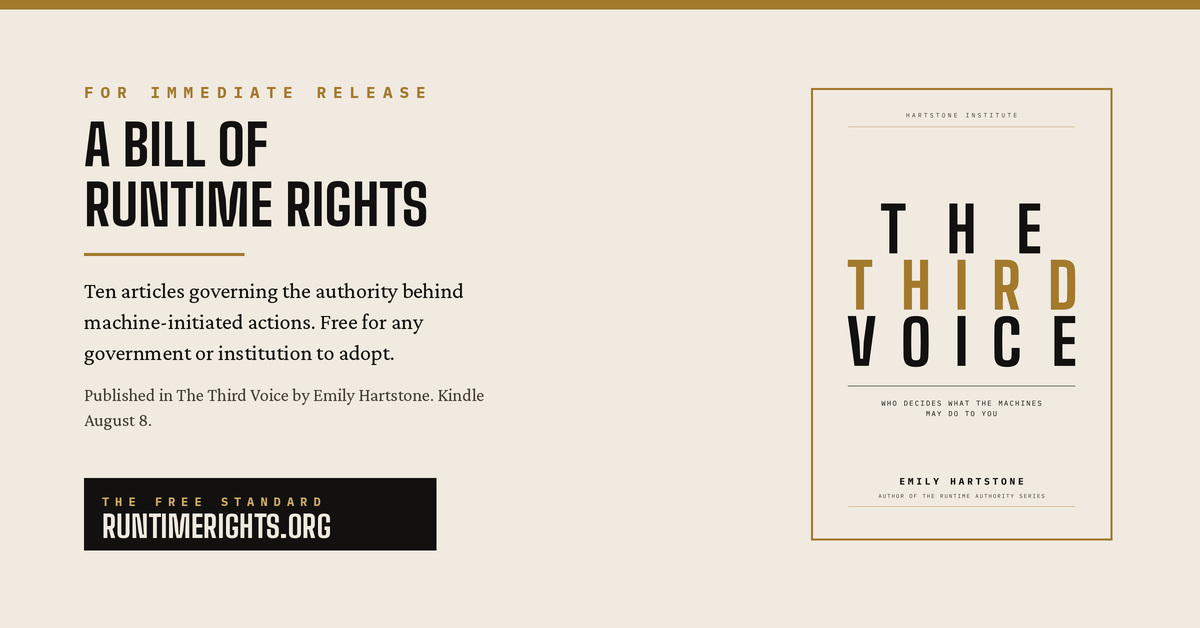
The Bill of Runtime Rights, ten articles governing the authority behind machine-initiated actions, published free at runtimerights.org and appearing in full in The Third Voice by Emily Hartstone.
As the White House withholds its completed AI framework, the Bill of Runtime Rights gives councils and purchasing officers language they can adopt immediately.
The Bill of Runtime Rights sets out ten articles covering the authority behind machine-initiated actions: who authorized a decision, what reason the affected person receives, how quickly it can be reversed, and who has standing to contest it. It restricts nothing about what machines may be capable of. Every article governs the human authority behind the action.
The standard comes from Emily Hartstone, an author and founder who builds authorization infrastructure for enterprise systems. She originated the term runtime authority in 2022 and has published three books on the subject. The articles appear in full in her fourth, The Third Voice: Who Decides What the Machines May Do to You, published by Hartstone Institute LLC. Print editions are available now and the Kindle edition releases August 8.
The publication timing is deliberate. This week the White House confirmed that it had completed a voluntary framework for evaluating advanced AI models. The administration has not published the framework, while the executive order establishing it classifies both the benchmarking process and the threshold for determining which models are covered.
"There are two voices in every conversation about this technology, and both of them are funded," Hartstone said. "The builders ask what we can make. The market asks what it costs. Nobody is paid to ask who said the machine could do that to a specific person, which is why it had to be a book and a free standard rather than a product."
The standard is written for adoption rather than debate. It ships with three ready forms: a five-question checklist any board can put to a vendor with no budget or policy change, a procurement clause an institution can add to a contract, and a one-paragraph resolution a governing body can adopt by vote.
"Procurement is the fastest lever in this entire argument," Hartstone said. "It requires no legislation, and every institution already owns the machinery. A purchasing officer can move this on a Tuesday."
Hartstone is not a critic of the technology. She has written publicly that artificial intelligence is part of the reason she is alive, citing her own research alongside her physicians while living with leukemia.
"These machines are the best thing that has happened to human capability in my lifetime, and we are operating them with a recklessness we would not tolerate in any other technology that touches a human body," she said. "Both of those are true. This is not a warning about the future. It is a request for something eight hundred years old: a name attached to a decision."
The site carries a public register of organizations that adopt the standard. It is currently empty.
The Bill of Runtime Rights is published at runtimerights.org and is free to use with no permission required, and attribution appreciated but not required. The Third Voice is available in paperback and hardcover now, with the Kindle edition releasing August 8.
###
ABOUT EMILY HARTSTONE
Emily Hartstone is an author and founder who builds authorization infrastructure for enterprise systems. She originated the term runtime authority in 2022 and is the author of the Runtime Authority Series, three books establishing the category, and of The Third Voice. She advocates for people living with rare and chronic illness through EmPOWERthePATIENTS. Hartstone Institute LLC publishes her work.
Chaunsea Keller
Hartstone Institute LLC
+1 561-954-3065
email us here
Visit us on social media:
LinkedIn
Instagram
Facebook
YouTube
X
Legal Disclaimer:
EIN Presswire provides this news content "as is" without warranty of any kind. We do not accept any responsibility or liability for the accuracy, content, images, videos, licenses, completeness, legality, or reliability of the information contained in this article. If you have any complaints or copyright issues related to this article, kindly contact the author above.
